The Wall-Mounted Blanket Rack: Beautiful Throw Storage That Doubles as Decor
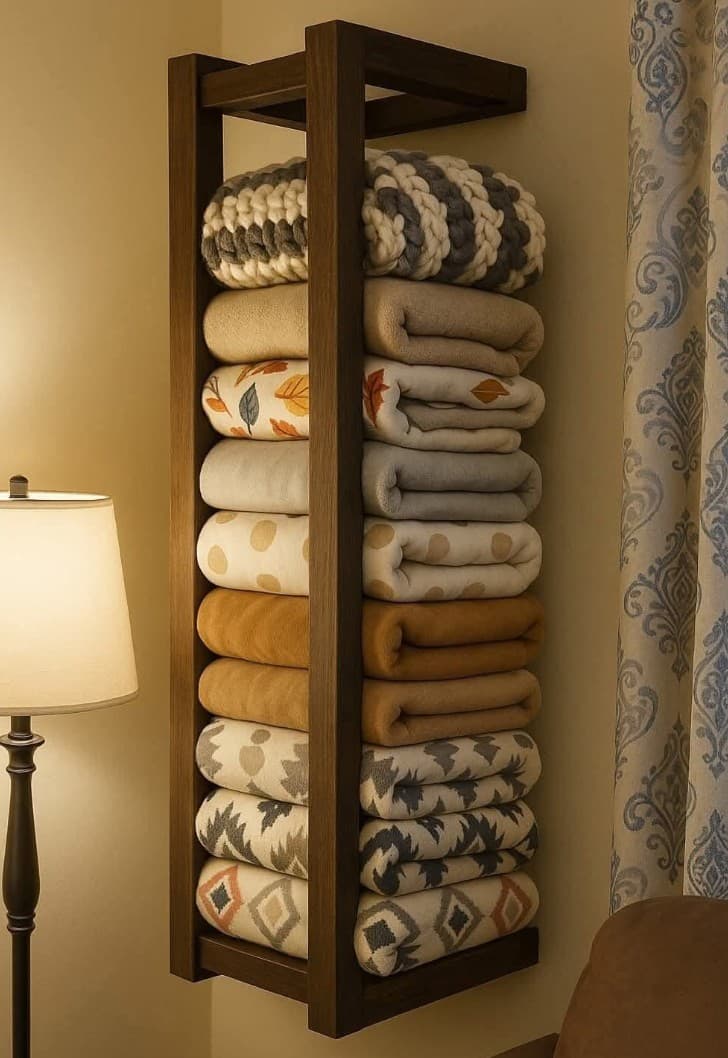
Against a warm amber wall, a tall dark walnut-toned wooden rack holds eight throws and blankets, each folded or rolled and stacked from top to bottom. From the top: a chunky grey-and-cream knit, a grey striped fleece, an autumn-leaf patterned blanket in rust and cream, a plain soft grey, a cream with scattered dots, a mustard yellow, another cream, and at the bottom, a bold geometric aztec print in ochre and grey. Every throw is different in colour, texture and pattern — and together they look extraordinary. A simple floor lamp stands to the left. This is storage that has become a piece of wall art.
Why a blanket rack works where a basket doesn't
A blanket basket — the usual solution — hides throws out of sight, which means they tend to be forgotten between uses. It also requires you to dig through a pile to find the one you want. A wall-mounted rack displays every throw individually, making them visible and inviting. You can see exactly what you have, reach the one you want without disturbing the others, and the whole arrangement becomes a visual feature of the room.
The rack itself
The rack here is a simple rectangular frame in dark stained wood — tall and narrow, about 40 cm wide and 120 cm tall, with horizontal rods across the inside at regular intervals, each holding one or two folded throws. The dark wood contrasts warmly with the amber wall behind it and reads as furniture rather than a utility item. This style of rack is available ready-made or can be built from a few pieces of dowel and timber.
How to fold for display
The throws here are folded in two different ways: some are folded in thirds lengthwise and then in half, creating a compact rectangular bundle; others are rolled. The mix of folded and rolled creates a varied silhouette across the rack, which is more interesting than a uniform row. Colours are arranged with the lightest and chunkiest at the top, graduating to the most graphic pattern at the bottom.
Choosing the throws
The eight throws here span three categories: chunky knit (the large grey-cream at the top), fleece or velour (the solid and patterned mid-section), and woven or printed throws (the aztec at the bottom). This variety in texture is what makes the collection visually rich — a rack of eight identical fleece throws would read as inventory, not decoration.
Interior tips
- Arrange throws from heaviest texture at the top to most graphic at the bottom: the eye reads from top to bottom, and starting with the most tactile piece (the chunky knit) before building to the most patterned (the aztec) creates a satisfying visual journey.
- Keep the colour palette within a warm family: the collection here is all in warm tones — cream, grey, mustard, rust, ochre. A cold blue or bright primary colour would stand out awkwardly. Decide on a palette before you build the collection.
- A wall rack works best against a warm-coloured wall: the amber paint here makes the dark wood glow. Against a white wall, the rack would need the throws alone to provide the warmth.
- Roll the thinner throws, fold the thicker ones: rolled fleece or cotton blankets take up less space and show their colour better; thick knits are better folded where their texture shows most clearly.
- Replace throws seasonally: heavy knits in winter, lighter cotton throws in summer. The rack looks good year-round, but its contents can change with the seasons.
Where to find or build the rack
The rack itself is a simple piece that can be sourced ready-made or built in an afternoon.
Ready-made options:
- Freestanding quilt and blanket racks (the kind traditionally used in bedrooms) are available from homeware retailers and are often exactly the right width and height. Look for ones in walnut, dark oak or black-stained finishes to match the aesthetic here.
- Towel ladders — the tall, leaning style — can be mounted to the wall with two small brackets and work well as a blanket display. Slightly more casual in proportion, but very effective.
- IKEA's ENUDDEN or similar wooden wall racks can work if modified — add extra dowel rods across the width at regular intervals using wooden dowels and wood glue.
Building your own:
The simplest version is a rectangular frame of 4 x 2 cm planed timber — two vertical uprights, two horizontal end pieces, and five or six cross-dowels at equal spacing. The frame mounts to the wall on two French cleats (a simple angled bracket system that allows the rack to hang level and be removed without tools).
Dimensions: 40 cm wide, 120 cm tall, dowels spaced 18–20 cm apart. At this spacing, each rod holds one folded throw comfortably. Use 18 mm wooden dowel rod, available from any timber merchant.
Sand everything to 180 grit and finish with a dark walnut or ebony wood stain, followed by a coat of clear matte wax.
Building a throw collection worth displaying
A rack this good needs throws that are worth looking at. Building the collection deliberately, rather than buying whatever is on sale, makes the difference between a beautiful display and a laundry pile on a stick.
What to look for:
- Chunky knit throws: the Icelandic or Nordic style — large, irregular stitches in natural wool or cotton. These are the most tactile and most visually interesting. Good sources include Etsy sellers who hand-knit to order, Scandinavian homeware brands, and charity shops during autumn turnover.
- Woven cotton throws with geometric patterns: the aztec or south-western style woven throw is a staple of this look. These are widely available at homeware chains and are usually inexpensive.
- Plain fleece or velour throws: the filler pieces. Solid colours in your palette — grey, cream, mustard — provide visual calm between the more textured or patterned pieces.
Budget tip: build the collection gradually. One good chunky knit as the hero piece, two or three plain throws as the supporting cast, and a patterned throw or two at the bottom is enough to fill a rack of this size without spending a lot at once.
Common mistakes with blanket display
Mismatching colour temperatures. The most common error is combining warm tones (cream, mustard, rust) with cool ones (ice blue, silver grey, mint green) on the same rack. The result looks accidental. Every throw in the collection should share the same warmth — all warm-toned, or all cool-toned. Warm usually reads better in a living room context.
Using identical folds for every throw. A rack where every throw is folded the same way looks like a shop display rather than a curated home collection. Mix folded and rolled, vary the exposed edge direction, and let slightly different widths create a varied profile across the rack.
Hanging the rack too high. A rack mounted near the ceiling looks inaccessible and implies the throws are decorative-only. Mount it at a height where the lowest throw is at easy reach — typically with the bottom of the rack at around hip height. The throws should be visually present, not museum-distant.
Related posts
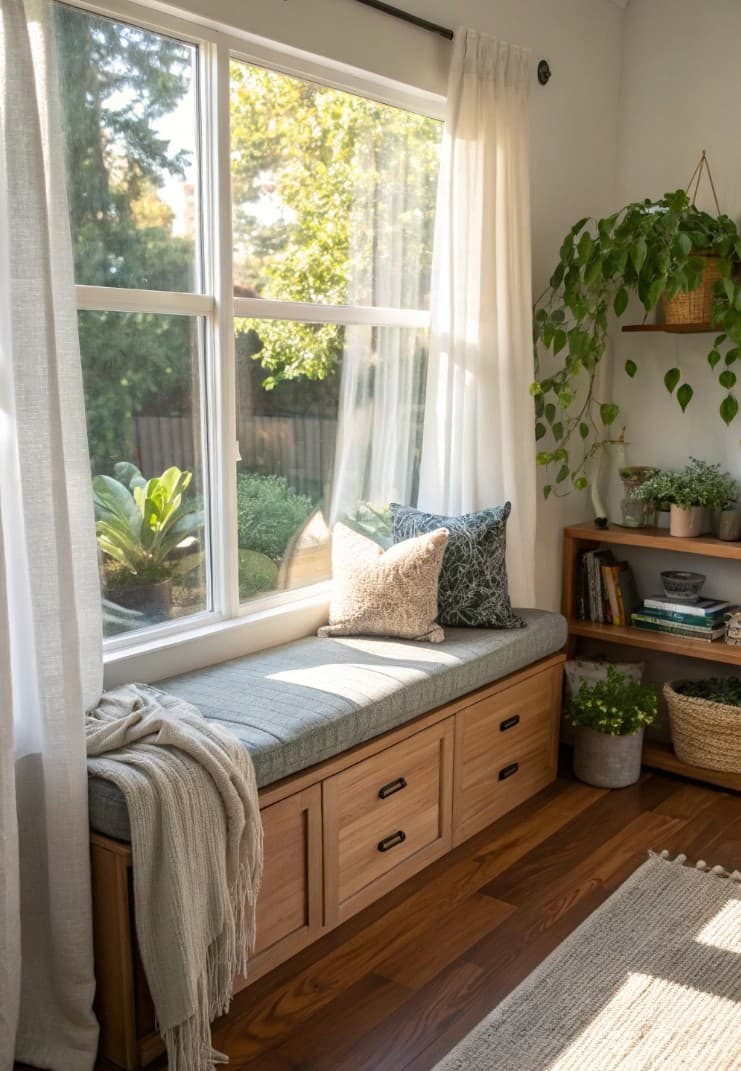
How to Build a Window Seat With Built-In Storage Drawers
A window seat with drawers underneath adds seating, storage and a reading nook in the space a window usually leaves empty.
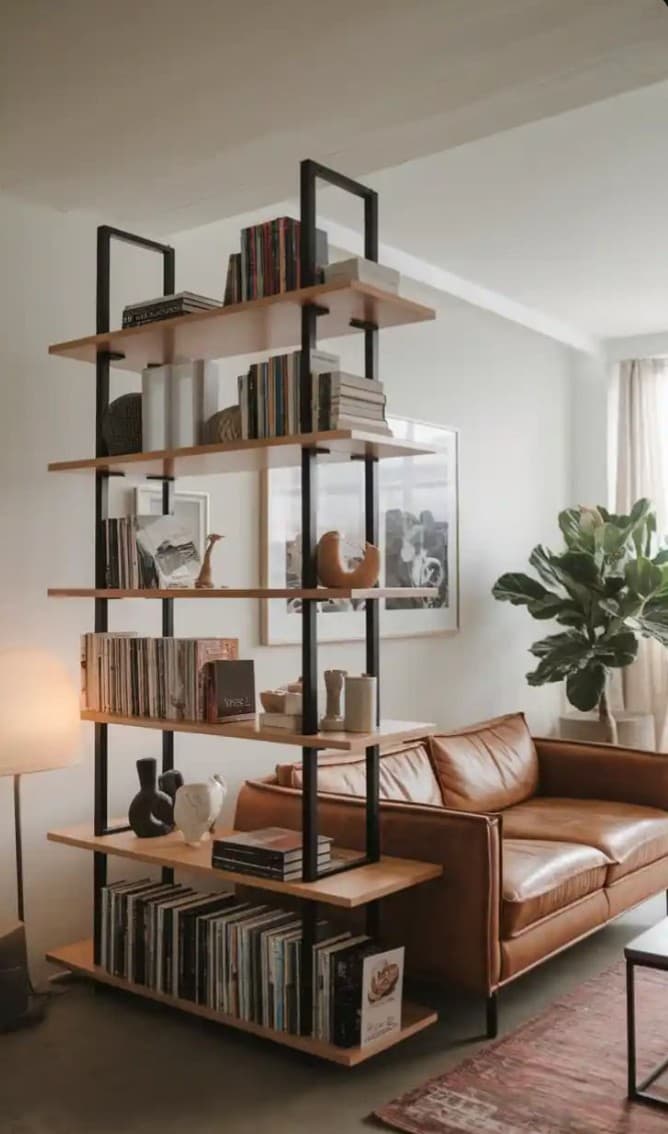
Industrial Shelving Units: The Statement Storage Piece for Modern Living Rooms
A tall black-frame, oak-shelf freestanding unit with books, ceramics and vinyl records becomes the focal point of a living room — here's how to style one.
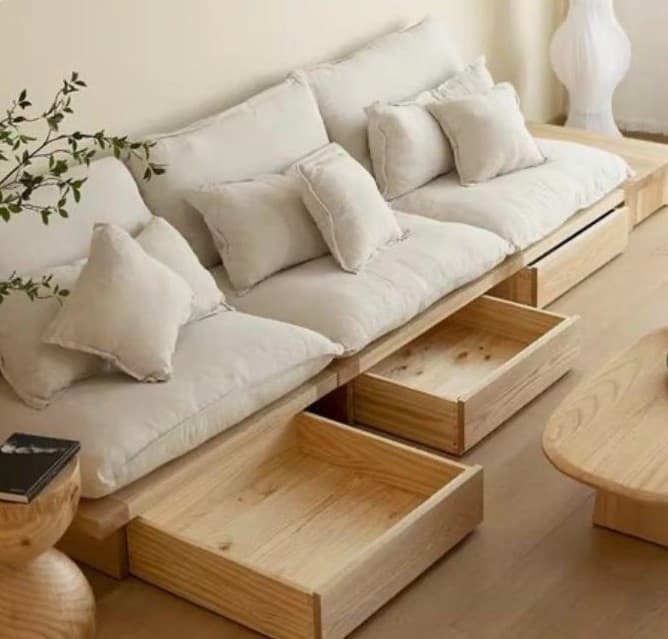
Japandi Platform Sofa With Hidden Storage Drawers: The Ultimate Space-Saver
A low pine platform sofa with pull-out drawers underneath stores as much as a wardrobe while taking up the footprint of a sofa. Here's why this is one of the smartest furniture ideas around.