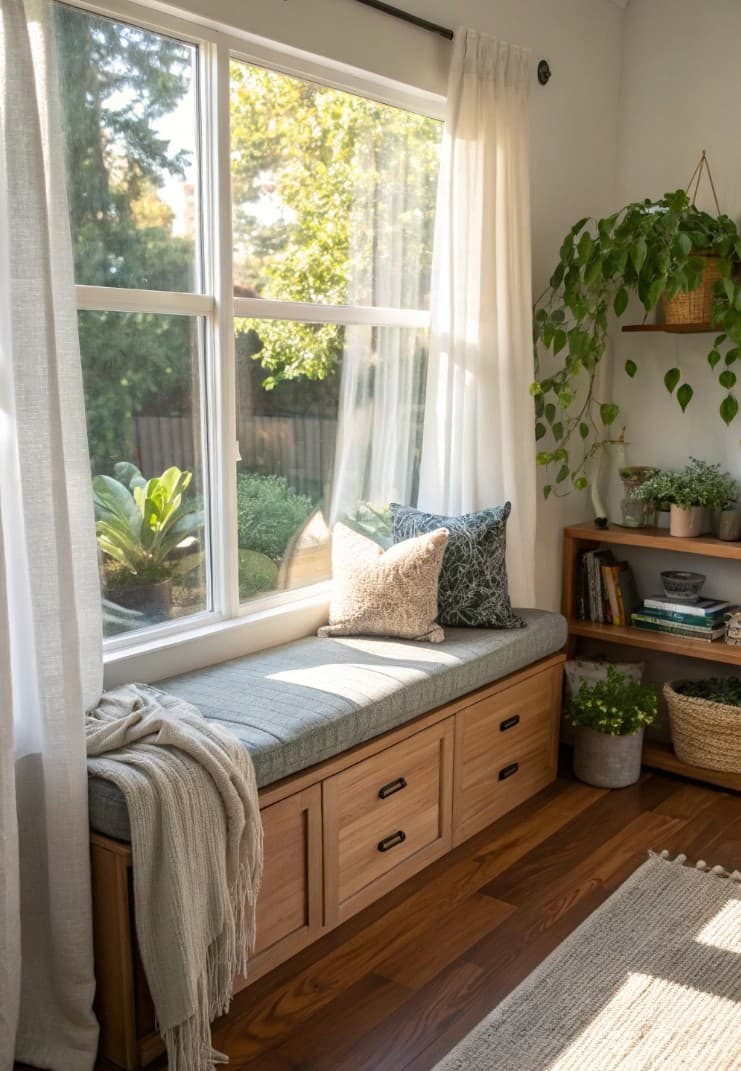
A window seat with built-in storage drawers is one of those home features that makes you feel like you live in a much more considered, well-designed space. The one pictured here — a wide oak bench with three deep drawers, a thick cushion in cool grey, and decorative pillows — sits in a garden-facing window with sheer curtains and afternoon light pouring in. Beside it, a bookshelf with plants. In front, a hint of a rug. It is everything a reading nook should be.
Why window seats work
A window seat solves three problems simultaneously: it gives you somewhere to sit that isn't the sofa (important for a sense of variety in how you use a room), it stores things that would otherwise have no home (the drawers here could hold books, throws, board games or seasonal items), and it makes a window into an architectural feature rather than just a hole in the wall.
Building or buying a window seat
Custom built-in window seats are the best version but require carpentry skill or a tradesperson. A simpler approach: buy a low bookcase or storage bench of the right depth, position it under the window, and add a custom-cut cushion on top. The result looks almost as good for a fraction of the cost.
Choosing the cushion
A thick cushion — at least 8–10 cm deep — is what makes a window seat genuinely comfortable rather than decorative. Choose a fabric that wipes clean (boucle and performance linen are popular choices), in a colour that works with your wall and curtain tones. Shades of grey, sage, dusty blue and warm cream are the most versatile.
The plants and bookshelf beside it
The bookshelf to the right of the window seat is a perfect companion: books to read, plants at different heights, a ceramic pot or two. Together they reinforce the sense that this is a deliberate, loved corner rather than a leftover space.
Interior tips
- Use sheer curtains rather than blackout blinds at a window seat — the point is the light, and sheers filter it beautifully without blocking it.
- Add a throw blanket draped casually over one end of the cushion — it signals that this is a place to relax and adds warmth to the corner.
- Pull-out drawers are more practical than lift-up lids in a window seat because you can access them without moving the cushion.
- Keep the pillows simple: two or three in different textures and a coordinating pattern. Too many cushions make sitting down an exercise in rearranging.
- A small side table nearby — for a cup of tea, a phone and a candle — completes the reading nook and makes it actually usable.
DIY vs. professional installation
A window seat with drawers is within reach for a competent home improver, but it's worth understanding what you're taking on before you start.
The simplest approach — and the one that works well in rented homes — is the "furniture stack" method: buy a low storage unit (like IKEA's KALLAX or similar cube shelving on its side), position it under the window, and top it with a custom-cut foam cushion wrapped in your chosen fabric. This takes a weekend and costs a fraction of a custom build.
For a fully built-in look with flush drawers and a seamless painted finish, you'll need either solid carpentry skills or a joiner. The cost varies widely, but expect to pay £500–£1,500 for a professional carpenter to build a bespoke window seat with three to four drawers, depending on size and material. The result is worth it — a built-in window seat adds perceived value to a home in a way that freestanding furniture never quite matches.
Making the most of your reading nook
A window seat only functions as a reading nook if the surrounding environment supports it. The shelf beside the window in this image is key: accessible books, a plant at eye height, something small and decorative. The subconscious message is that this is a place for slow, quiet activity — and that message encourages you to actually use it that way.
Consider the following additions to make the nook feel complete:
- A clip-on or adjustable arm reading light for evening use, positioned to light the page without casting glare on the window
- A small wicker basket or tray on the seat itself for glasses, bookmarks and hand cream — the small things that make a reading session comfortable
- Curtains that can be drawn, to cocoon the nook on rainy or dark afternoons and increase the sense of enclosure and warmth
What to store in the drawers
Deep storage drawers under a window seat are surprisingly generous in capacity. The most practical uses are:
- Extra bedding (duvets, spare pillows) — the single most common use and very effective
- Out-of-season clothing in vacuum storage bags
- Children's toys and games in labelled fabric boxes
- Books that overflow from nearby shelving
- Sports or hobby equipment (yoga mat, rolled-up maps, craft supplies)
The important thing is to assign each drawer a category and stick to it. A window seat with drawers full of random items becomes a problem to open rather than a pleasure.
Common mistakes when building a window seat
Choosing the wrong cushion depth. A 4 cm cushion feels like sitting on a shelf. Spend more on a foam cushion that's at least 8 cm deep — 10 cm is even better. Dense foam (35–40 kg/m³) holds its shape and doesn't bottom out the way cheap foam does.
Ignoring the reveal. If there's a window reveal — the recessed wall space between the window frame and the room — build the seat to fit inside it exactly. A seat that's slightly too narrow for the reveal looks provisional; one that fills it precisely looks architectural.
Making it too perfect to sit on. A window seat loaded with perfectly arranged cushions that have to be rearranged before you can sit is a window seat no one actually uses. Keep it simple: one cushion base, two or three pillows, one throw.
Related posts
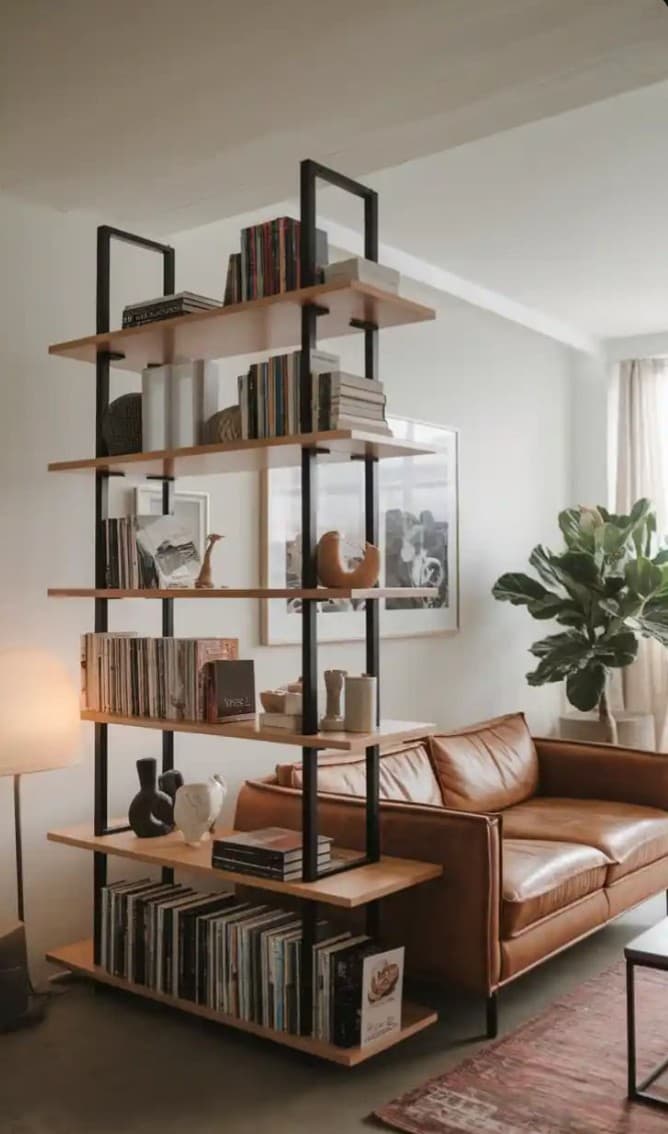
Industrial Shelving Units: The Statement Storage Piece for Modern Living Rooms
A tall black-frame, oak-shelf freestanding unit with books, ceramics and vinyl records becomes the focal point of a living room — here's how to style one.
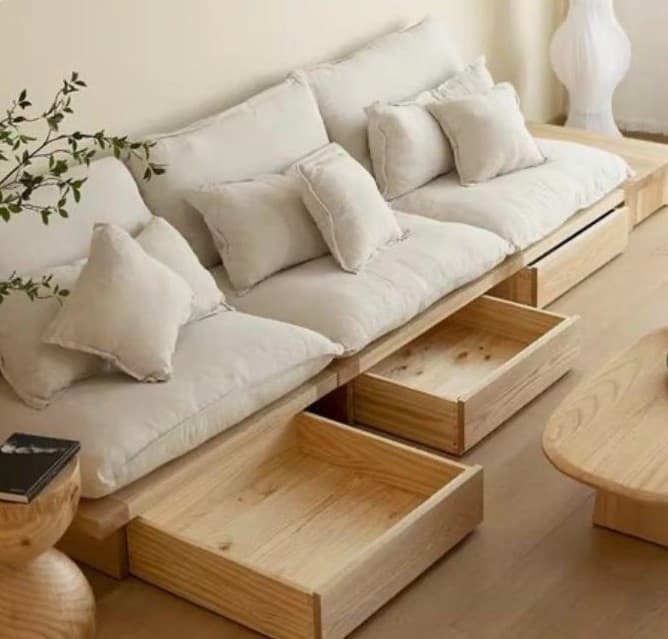
Japandi Platform Sofa With Hidden Storage Drawers: The Ultimate Space-Saver
A low pine platform sofa with pull-out drawers underneath stores as much as a wardrobe while taking up the footprint of a sofa. Here's why this is one of the smartest furniture ideas around.
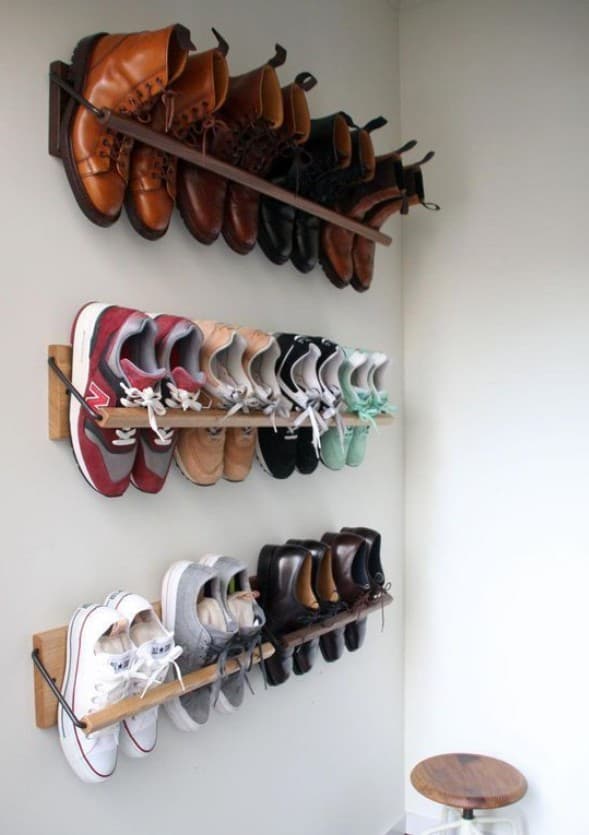
Wall-Mounted Shoe Rails: The Smartest Shoe Storage Idea
Tired of shoes cluttering your entryway? Wall-mounted shoe rails keep everything visible, accessible and off the floor — and they look great doing it.