The Wildest Cabin Kitchen: Distressed Fridge, Open Jar Shelves and a Forest View
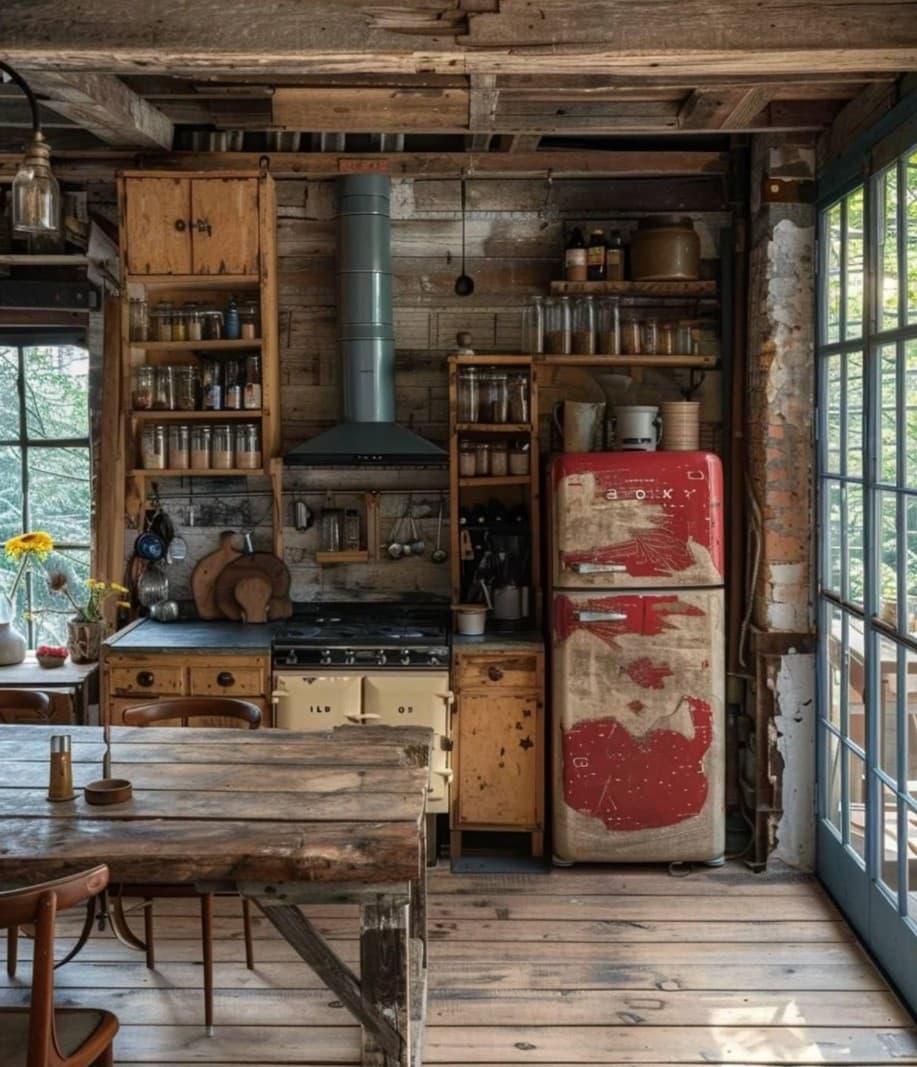
There is a vintage refrigerator in this kitchen that has lost most of its paint. What remains is a skin of raw red paint in patches, peeling back to reveal the bare cream enamel beneath and in some areas the metal itself. It is one of the most characterful objects in any kitchen imaginable. Around it: open pine shelves packed with glass preservation jars containing dried goods — rice, pulses, spices, seeds, herbs — all labelled and catching the light from the large forest-facing steel window beside them. A black cast iron range with a galvanised steel duct hood dominates the back wall. The ceiling is exposed timber beams. The walls are raw wood planks. The floor is wide-plank pine. A rustic dining table with bentwood chairs sits in the foreground. A hanging glass jar light provides overhead light. This is not a kitchen designed by an interior decorator. It has been assembled, and it has been lived in.
The vintage refrigerator as a character piece
A refrigerator becomes a design feature only when it has been lived with for long enough to develop its own history. The fridge here is a 1950s or early 1960s model — rounded top, tall narrow proportions, a handle rather than a recessed pull. The paint loss is not cosmetic damage: it is a document of the appliance's life, showing where it was handled, where it was moved, where moisture found its way under the surface over decades. To replace it with a new refrigerator would be to lose the most singular element in the room.
Open shelves with glass jars
The open pine shelves running from counter height to ceiling hold a systematic collection of glass preserving jars — Kilner or Weck-style jars in different sizes, uniformly filled and labelled. This is both a practical storage system (everything is visible, nothing is buried at the back of a cupboard) and an aesthetic one. The layered depths of the jars — dark pulses at the bottom, pale grains above, dried herbs at the top — create a gradient that reads almost as a botanical display.
The cast iron range
The black cast iron range with its large burners and old-fashioned proportions is the room's functional centrepiece. The galvanised steel duct hood above it is oversized by modern standards — wider than the range, extending further into the room — and this scale makes it feel appropriately industrial for the space. A black range in a kitchen of natural wood is exactly the right contrast: the darkness of the metal makes the warmth of the pine visible in a way it wouldn't be against light cabinets.
The forest view
The large steel-framed windows looking out onto trees are the room's single most valuable element. Natural light from the forest — filtered, green-tinged, moving as the trees move — fills the kitchen in a way that artificial light cannot replicate. The connection between the kitchen interior (warm, preserved, aged) and the forest exterior (raw, wild, living) is the defining quality of this space.
Interior tips
- A vintage fridge looks best when it looks old: resist the temptation to repaint, recoat or restore an aged refrigerator. The paint loss is what makes it interesting. A freshly repainted vintage fridge looks like a costume; a worn one looks like itself.
- Glass jars on open shelves work because they're systematic: the effect here comes from using the same jar type throughout. Mixed packaging, mixed sizes, mixed materials would look like a mess. Uniform jars look like a library.
- A cast iron range needs an appropriately scaled hood: too small a hood over a large range looks unbalanced. The hood here is deliberately oversized, which gives it authority and makes the range feel properly equipped.
- Expose the construction: the visible beams, the raw plank walls, the wide-board floor — none of these are covered or finished. Showing the building's structure is the most honest and most beautiful approach in a cabin kitchen.
- A dining table in the same room as the range makes the kitchen social rather than functional. The cook and the guests are in the same room; the smells, the sounds and the light are shared. In a cabin, this is how kitchens should always work.
Related posts

How to Frame a Doorway with Plants for a Stunning Kitchen View
Trailing plants on a shelf above a black-framed doorway, floor plants on either side, and a warm Scandi kitchen beyond — how to make a transition space the most beautiful part of your home.

The Hygge Living Room: Layering Textures, Candles and Natural Materials
Patterned cushions, chunky knit throws, wooden tray tables, candles and eucalyptus — how to build a living room that feels genuinely cosy all year round.
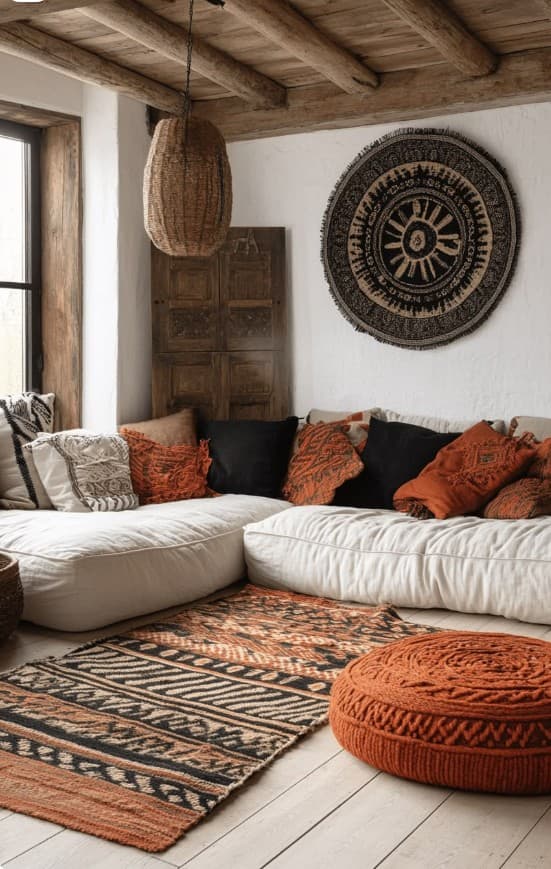
Rust, Black and White: The Boldest Boho Palette in One Living Room
A low white sectional sofa loaded with rust-orange ethnic cushions, a black circular wall tapestry, a bold kilim rug and a rattan pendant — this is boho living room design at its most confident and distinctive.