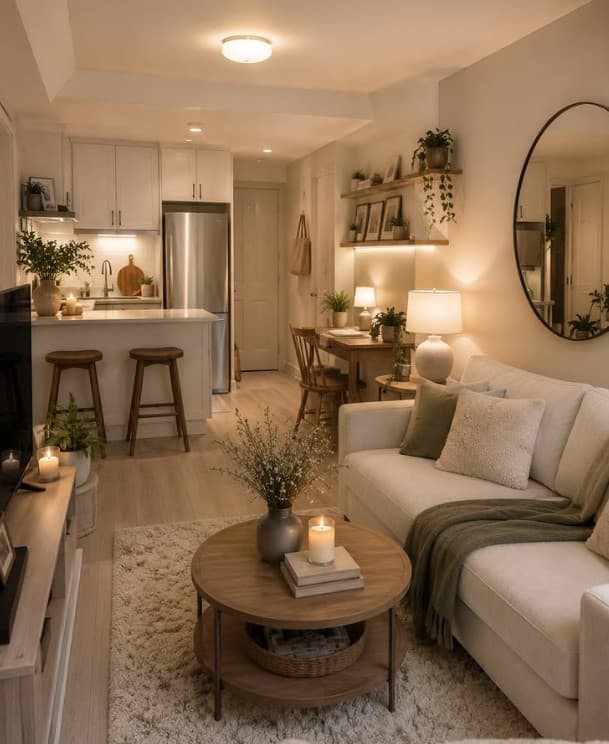
A small apartment can look completely different at night than it does during the day — and in the best cases, the evening version is the better one. The apartment pictured here glows. Candles on the coffee table, warm LED lighting under the kitchen cabinets, a table lamp in the dining nook, recessed ceiling lights set to low. Every light source is intentional, and together they make a space of probably 45–50 square metres feel rich and inviting.
Layer your lighting — never rely on one source
The golden rule of evening lighting is the same in a studio apartment as it is in a large house: never rely on a single overhead light. The ceiling fixture in this apartment is clearly on low or off entirely. The light comes from the kitchen's under-cabinet LEDs, the table lamp in the dining corner, and the candles on the coffee table. Three sources, three different heights, one cohesive warm atmosphere.
A good way to audit your own lighting is to turn off every light at dusk and then turn on sources one at a time, asking whether each one adds something specific — task light, ambience, accent — or just adds brightness. Brightness alone, without warmth or directionality, is what makes a room feel clinical.
Choosing the right bulbs
This is the most important and most overlooked step. The colour temperature of a bulb determines whether a room feels warm or cold:
- 2200–2400K (very warm white, amber) — ideal for living rooms, bedrooms and any space where you want maximum cosiness. Edison filament bulbs fall in this range.
- 2700K (warm white) — the standard for residential spaces, works well for most rooms including kitchens
- 3000K (neutral warm white) — acceptable for task areas like kitchen counters, but verges on cool for a living space
- 4000K and above (cool white or daylight) — suitable for workspaces and bathrooms, but avoid in any room where you want to feel relaxed in the evening
In a small apartment, all sources should ideally sit in the same temperature range. Mixing a 2700K lamp with a 4000K kitchen ceiling light creates a disconnected, slightly wrong feeling that's hard to diagnose unless you know to look for it.
Candles as a design element
The candles on the round coffee table aren't just functional — they're part of the styling. Three white pillar candles on a wooden tray, surrounded by a small dried-flower arrangement. This is the simplest, cheapest way to elevate an evening scene. The rule: always group candles in odd numbers, always use a tray or plate beneath them, always choose unscented or lightly scented varieties so they don't compete.
For pillar candles, high-quality alternatives to paraffin include beeswax (burns cleaner and longer, with a naturally warm honey scent) and soy wax (more affordable, holds fragrance well). Avoid cheap paraffin pillar candles — they produce soot and the wax quality means uneven burning that looks untidy after the first use.
Installing a layered lighting plan
If you're starting from scratch with evening lighting in a small apartment, build it in this order:
- Sort the main ceiling light first: put it on a dimmer if possible. A ceiling light that goes all the way down to a very low level is far more useful than one that only dims to 50%.
- Add one floor lamp beside the sofa — this becomes your primary evening light while the ceiling light is low or off
- Add a lamp in every other zone — a small table lamp in the dining area, a bedside lamp in the bedroom
- Install kitchen under-cabinet LEDs if you haven't already — these are low-voltage strips that can be fitted by a confident DIYer in under an hour
- Add candles last, as the final layer of warmth that activates only in the evenings
The round coffee table
The round wooden coffee table with a lower shelf is a very practical choice for a small living room. The round shape means there are no sharp corners to navigate around, the lower shelf provides extra storage or display space, and the warm wood tone anchors the neutral sofa and rug. A round table with visible grain always looks warmer than a glass or painted surface.
Bar stools at the kitchen counter
The two wooden bar stools at the kitchen island do double duty: they provide casual seating for two people without the footprint of a dining table and chairs, and they create a natural division between the kitchen and living areas. In a small apartment where the kitchen opens directly onto the living room, this boundary matters.
The stool height is important: for a standard bar counter at 90–100 cm, you need bar stools at 65–75 cm seat height. Measure before you buy — stools that are too short look wrong and are uncomfortable to use for any length of time.
Common mistakes in small apartment lighting
The most common mistake is relying entirely on the ceiling light that came with the flat. A single overhead light source creates flat, shadowless illumination that makes even beautiful furniture look uninviting. This is the first thing to address.
The second mistake is buying cheap warm-white LED bulbs that turn out to be slightly pink or slightly green rather than genuinely warm. Reputable brands (Philips, OSRAM, GE) are worth the small premium — their warm whites are genuinely warm. Cheap no-brand bulbs are often inconsistent.
The third mistake is placing all the lamps at the same height — typically table-lamp height. Good layered lighting works across three levels: ceiling (pendant or recessed), mid-height (floor and table lamps) and low (candles and under-furniture accent lights). Even one source at each level makes a dramatic difference to how the room feels.
Candle safety in a small apartment
Candles in a small space deserve more attention than they typically get. Simple habits that eliminate risk:
- Never leave candles burning when you leave the room or go to sleep
- Use a candle snuffer rather than blowing — blown candles produce more smoke and can send a spark
- Keep candles at least 30 cm from curtains, cushions and paper — in a small apartment where everything is closer together, this requires conscious placement
- A candle tray is not optional — wax drips, and wax on a wooden surface is difficult to remove without damage
Interior tips
- Put all your main lights on dimmers — this single change gives you complete control over the mood in every room, and it's cheap relative to what it does.
- A round mirror on the wall reflects candlelight and lamplight back into the room, making the space feel twice as bright without adding another light source.
- Under-cabinet LED strips in the kitchen are inexpensive to install and completely change how the kitchen looks in the evening — the countertop becomes lit from above and below simultaneously.
- Keep the dining nook small: a two-person table with two chairs, tucked into a corner with a lamp overhead, creates a restaurant-like intimacy that a larger dining setup can't match.
- A green throw on the sofa picks up the plant colours and ties the living area together — it's also the first thing you reach for when you settle in for the evening.
Related posts

How to Style a Hallway with a Large Monstera and Uplighter
A statement monstera in a ribbed pot with an uplighter beneath it transforms a hallway into the most memorable part of your home. Here is how to do it well.
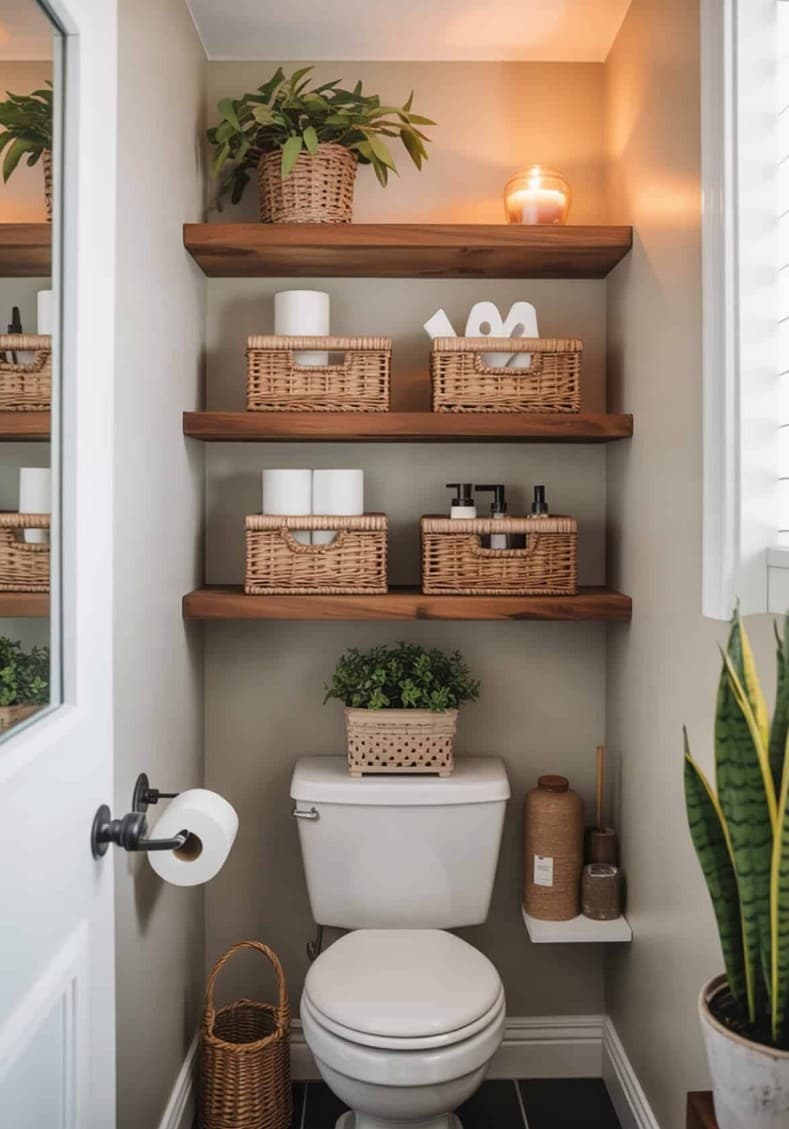
Three Walnut Shelves Above the Toilet: The Bathroom Storage Idea That Changes Everything
Three dark walnut floating shelves above the toilet, each holding wicker baskets with toiletries, a large plant, an amber candle and a snake plant on the floor — this is how to make a small bathroom look considered and beautiful.
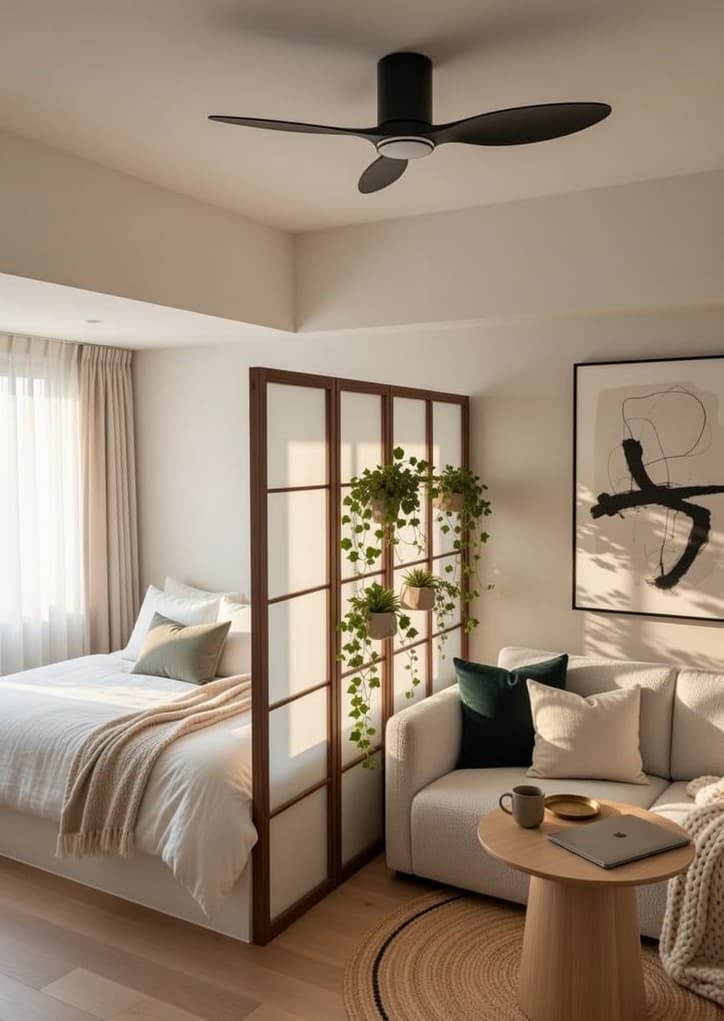
The Plant Room Divider: How to Separate a Studio Bedroom Without Walls
A wooden grid panel with hanging trailing plants creates a beautiful, light-filled boundary between sleeping and living zones — no construction required.