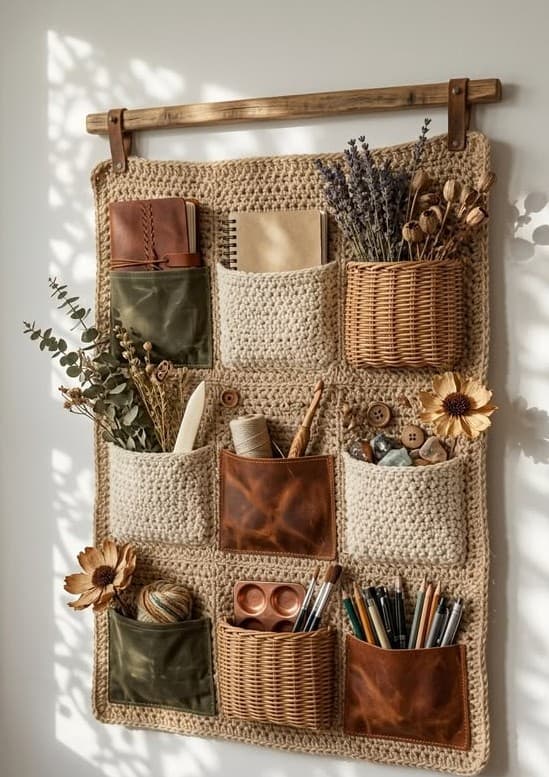
This wall organiser is a piece of functional art. A large crochet panel in natural jute, hung from a wooden dowel on leather straps, with pockets in three different materials — more crochet, soft leather and small wicker baskets. Inside those pockets: a leather journal, a spiral notebook, dried lavender and sunflowers, a ball of yarn, a crochet hook, buttons, art brushes and pencils. It is organised chaos made beautiful, and it hangs on a white wall like a tapestry.
What makes this organiser different
Most desk and wall organisers are plastic, metal or painted wood. They store things efficiently but add nothing to the room. A crochet organiser like this does the opposite: the texture, the natural fibres and the mix of pocket materials turn a functional object into something you'd choose to look at even if it weren't useful.
There is also something genuinely satisfying about handmade storage. Mass-produced organisers tell you that storage is a problem to be solved; a handmade crochet organiser tells you that organisation can be a pleasure.
The structure: dowel, straps and panel
The organiser hangs from a natural wood dowel — a thick branch or turned wooden rod — suspended by two leather straps from wall hooks. The strap mechanism means the panel hangs flat and can be easily removed and rehung. The crochet panel itself should be stiff enough to hold its shape but loose enough to drape naturally.
For the dowel, a birch or oak branch of around 3–4 cm diameter works well. Foraged branches (dried thoroughly first) have more character than turned wooden rods from a craft shop, and they're free. Sand the ends smooth and apply a thin coat of linseed oil to preserve them.
The three pocket types
Crochet pockets — the base material, worked in the same jute or natural cotton as the panel. Loose weave allows you to see the contents while keeping them in place.
Leather pockets — either purchased or cut from a piece of vegetable-tanned leather. The contrast of stiff, smooth leather against the soft crochet is the visual highlight of the piece.
Wicker basket pockets — small rattan or wicker baskets stitched or tied to the panel. These are the deepest pockets, ideal for bulkier items like a dried flower bunch, a ball of yarn or a collection of tools.
Choosing your yarn
The choice of yarn determines most of the organiser's visual character. Natural fibres work best:
- Jute is the most textural and the most authentically rustic. It's stiff enough that pockets hold their shape without lining. The natural brown tone is warm and pairs beautifully with leather.
- Cotton macramé cord gives a slightly softer result and comes in a wider range of natural tones — undyed, bleached white or pale grey.
- Linen is finer and produces a more refined, delicate result — better suited to a bedroom organiser than a craft-room one.
Avoid synthetic yarns entirely. Acrylic crochet has a plasticky sheen that undercuts everything that makes a handmade organiser special.
How to make it: a beginner's approach
You don't need to be an experienced crocheter to make a basic version. A simple grid stitch in a bulky yarn produces a sturdy panel in a few evenings. The pockets are worked separately and stitched on. The leather pockets can be purchased pre-cut from craft suppliers (search for "leather craft offcuts" or "leather scraps") and attached with a curved needle and waxed thread.
If you'd rather buy than make, Etsy has a strong market for handmade crochet wall organisers from independent makers — search for "jute wall organiser" or "macramé wall pocket." Expect to pay between £40 and £120 for a well-made piece, depending on size and complexity.
What to put in it
The contents visible here are carefully chosen: dried botanicals (lavender, sunflowers, eucalyptus) in the wicker pockets add colour and scent. Leather journals and notebooks sit in the leather pockets. Art and craft tools — brushes, pencils, a crochet hook — fill the smaller pockets. The mix of practical and decorative is deliberate and very effective.
Where to use it beyond the home office
A crochet wall organiser isn't limited to desk spaces:
- In the kitchen: hold recipe cards, small herb bundles, a hand towel and scissors
- In the bathroom: small cotton balls, dried botanicals, a soap bar and a small plant cutting in a test tube vase
- In a child's room: art supplies, small toys and a personalised name or alphabet letters worked into the design
- In the entryway: keys on a hook at the bottom, gloves, a postcard display
Common mistakes to avoid
Using it as a dumping ground is the most common mistake. A crochet organiser only looks beautiful when its contents are curated — when every pocket holds something that either needs to be there or looks good being there. Let clutter accumulate in a drawer instead.
The other mistake is hanging it too low. These pieces need to be at or slightly above eye level to read as wall art rather than as a container sitting on the floor. The top of the panel should sit at roughly 170–175 cm from the floor in a standard room.
Interior tips
- Hang it in a home office or craft room where the contents are actually needed — a beautiful organiser that requires you to cross the room to use it defeats the purpose.
- Refresh the dried flowers seasonally: swap lavender for eucalyptus in winter, add dried grasses and seed heads in autumn. The organiser becomes a seasonal object.
- Keep one pocket empty as a visual rest — a completely filled organiser stops reading as decor and starts reading as storage.
- Natural fibre on natural fibre looks best: jute, linen and cotton crochet suits leather and rattan. Synthetic yarns lose the artisanal quality entirely.
- A wooden dowel with visible grain is better than a painted or lacquered one — the natural texture ties back to the other materials in the piece.
Related posts

How to Frame a Doorway with Plants for a Stunning Kitchen View
Trailing plants on a shelf above a black-framed doorway, floor plants on either side, and a warm Scandi kitchen beyond — how to make a transition space the most beautiful part of your home.

The Hygge Living Room: Layering Textures, Candles and Natural Materials
Patterned cushions, chunky knit throws, wooden tray tables, candles and eucalyptus — how to build a living room that feels genuinely cosy all year round.
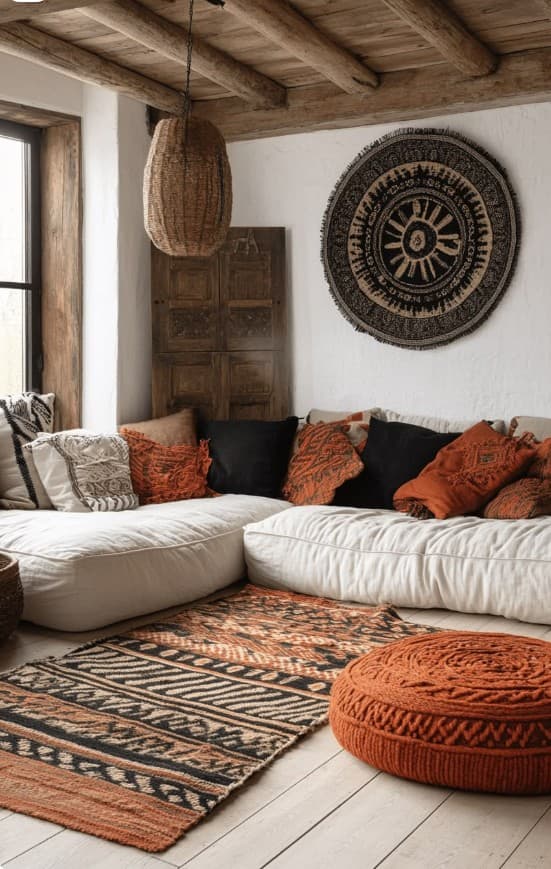
Rust, Black and White: The Boldest Boho Palette in One Living Room
A low white sectional sofa loaded with rust-orange ethnic cushions, a black circular wall tapestry, a bold kilim rug and a rattan pendant — this is boho living room design at its most confident and distinctive.