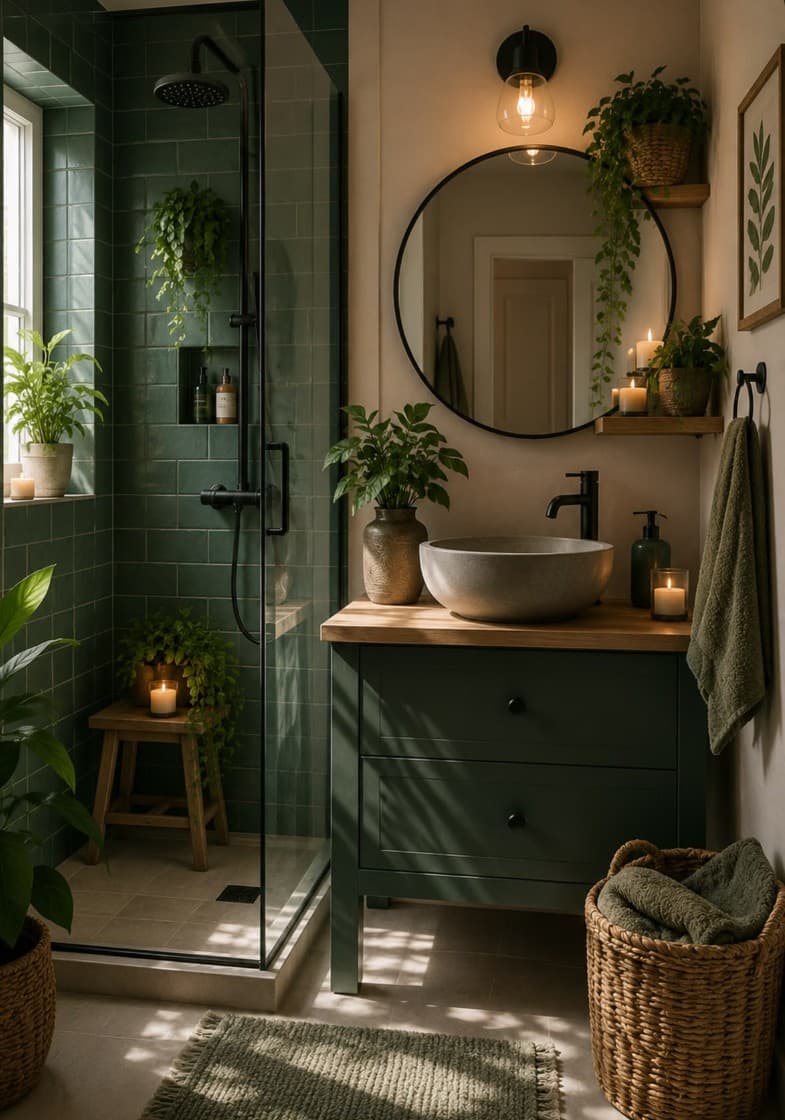
This bathroom should not work as well as it does. Dark green subway tiles floor-to-ceiling in the shower. A deep forest green vanity with a warm oak countertop. A round stone vessel sink. A single Edison bulb on a black wall sconce. Candles everywhere. Plants in every corner and on every surface. And yet it works — moody, warm, spa-like and deeply personal.
Deep green tiles: committing to colour
The shower tiles here are a deep, matte forest green in a classic subway format — stacked vertically rather than in the traditional brick pattern, which makes the tiles feel taller and more contemporary. The key to making dark tiles work in a bathroom is the grout: the same shade as the tile, or only slightly lighter, so the grid pattern doesn't dominate. White grout on dark tiles creates a checkerboard effect; matching grout creates a seamless wash of colour.
The dark green vanity
The vanity cabinet — dark green to match the tiles, with a warm oak countertop — demonstrates how effective a tonal palette can be. When the vanity and the shower tiles are the same family of colour, the room reads as a considered, cohesive design decision rather than a combination of separate choices. The black hardware (tap, soap dispenser) ties back to the black mirror frame, sconce and shower fittings.
Stone vessel sink
The round, organic stone (or concrete) vessel sink is the focal point of the vanity. Its rough, natural texture contrasts with the smooth painted cabinet below and the hard lines of the mirror above. A vessel sink like this demands a matching tap mounted high enough to clear the basin comfortably — the black matte tall tap here is the right choice.
Plants as the essential element
Without the plants, this would be a dramatic but cold bathroom. With them, it becomes alive. Plants appear in every available location: on the shower niche shelf, on the vanity counter, on a floating shelf above, in large floor pots in the corners, and even trailing from a wicker basket. The combination of deep green tile and living green plants creates a layered, rich effect — the tiles recede; the plants advance.
Interior tips
- Black fixtures throughout: one metallic finish for all taps, showerheads, hooks and mirror frames makes a bathroom feel intentionally designed rather than assembled from different sources.
- Candles in a bathroom are not just atmospheric — the warm, flickering light is genuinely more flattering than any artificial lighting for evening bathing or skincare routines.
- A round black-framed mirror is the perfect partner for a dark botanical bathroom: the circular form softens the rectangular grid of the tiles, and the black frame ties back to the hardware.
- Edison bulb sconces at face height, rather than overhead lighting, give much more even and flattering light for the bathroom mirror — overhead lighting casts unflattering shadows downward.
- A wicker basket on the floor holds extra towels while adding natural fibre texture that breaks up the hard surfaces of tile, stone and painted wood.
Which plants actually survive in a bathroom
Not every plant is happy in a bathroom, even one that looks like a jungle. The key variables are light and humidity. A bathroom with a small frosted window gets far less light than it appears to from the outside, and many tropical plants that look lush in a garden centre will slowly decline without enough of it.
The safest choices for a dark botanical bathroom:
- Pothos (Epipremnum aureum): practically indestructible, tolerates low light, loves humidity. Let it trail from a high shelf and it will grow a metre of new growth per year with minimal attention.
- Peace lily (Spathiphyllum): one of the few flowering plants that genuinely thrives in low light and humid conditions. Dark green foliage, occasional white flowers, very forgiving.
- Boston fern: the classic bathroom plant for a reason. It loves the humidity from the shower and will reward you with lush, feathery fronds — as long as it gets some indirect light and its soil is kept consistently moist.
- ZZ plant (Zamioculcas zamiifolia): the most drought-tolerant option here. Waxy, dark green leaves that look almost artificial, tolerates neglect and low light. A good choice for a bathroom that doesn't get much natural light.
- Spider plant: fast-growing, produces trailing babies, genuinely happy in a humid environment.
Avoid succulents and cacti in a dark bathroom — they need direct sunlight and dry air, which is the opposite of what a steamy shower room provides.
Common mistakes to avoid
Choosing white grout with dark tiles. This is the single most common error when tiling a dark bathroom. White grout creates a prominent grid pattern that dominates the surface — you see the grout lines, not the tile. Match your grout to your tile colour, or go only one shade lighter. The result should be a wash of colour, not a net.
Skimping on the ventilation. A bathroom full of plants, candles and steam is a recipe for mould if the ventilation isn't adequate. Make sure your extractor fan is powerful enough for the room size and run it for at least 20 minutes after every shower. Plants absorb some humidity, but they are not a substitute for proper airflow.
Mixing metal finishes. Black hardware throughout is the right call here. Bringing in a chrome tap or a brushed nickel towel ring alongside the black fittings breaks the considered feeling immediately. Decide on one finish before you buy anything and stick to it.
Over-lighting the room. A moody, atmospheric bathroom does not want a bank of bright downlights. Add dimmers to any overhead lighting, keep the wall sconces warm-toned, and treat bright overhead light as the functional exception — for cleaning, for applying makeup — rather than the default.
Neglecting the floor. Dark walls, dark vanity and dark tiles can make a bathroom feel like a cave if the floor is also very dark. Consider a lighter floor tile — warm grey stone, pale concrete effect, or even a small geometric patterned tile — to keep the space grounded without lightening the walls.
Related posts

How to Frame a Doorway with Plants for a Stunning Kitchen View
Trailing plants on a shelf above a black-framed doorway, floor plants on either side, and a warm Scandi kitchen beyond — how to make a transition space the most beautiful part of your home.

The Hygge Living Room: Layering Textures, Candles and Natural Materials
Patterned cushions, chunky knit throws, wooden tray tables, candles and eucalyptus — how to build a living room that feels genuinely cosy all year round.
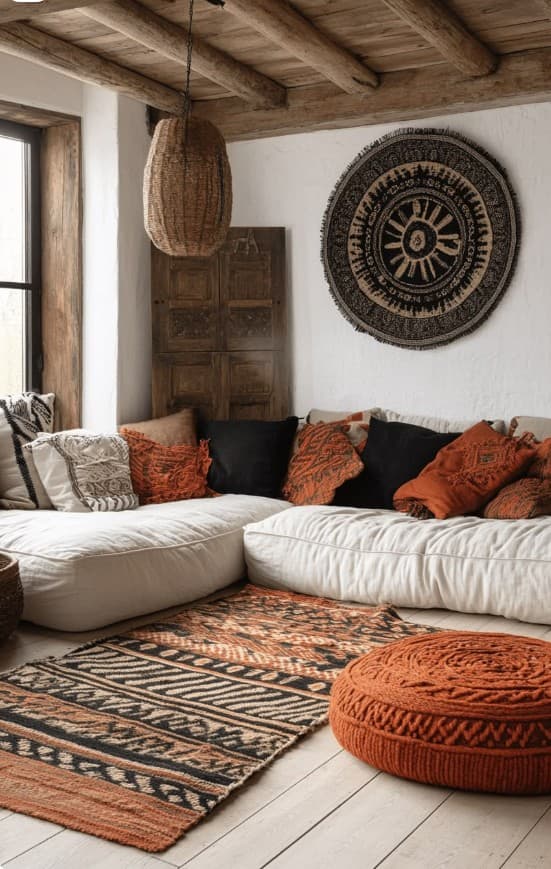
Rust, Black and White: The Boldest Boho Palette in One Living Room
A low white sectional sofa loaded with rust-orange ethnic cushions, a black circular wall tapestry, a bold kilim rug and a rattan pendant — this is boho living room design at its most confident and distinctive.