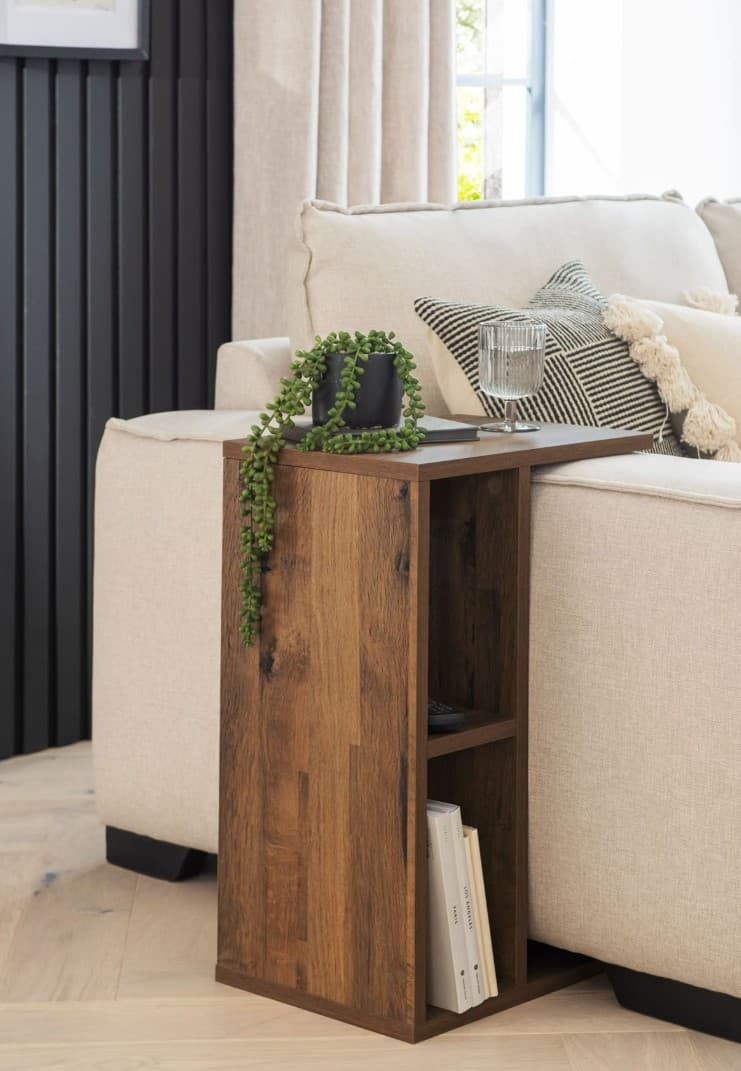
Most side tables sit beside the sofa — you reach across to them, or shuffle forward on your seat. This one slides underneath the sofa arm. The slim dark oak C-shape means the surface hovers at arm height while the base slides beneath the sofa, taking up no floor space beyond the sofa's existing footprint. On top: a small black ceramic pot with a trailing string-of-pearls plant, and a ribbed glass of water. In the open cubbies below: a TV remote, a few books. The sofa behind it is cream, heavily cushioned, informal. Tall black slatted wall panelling runs up the wall. The whole thing is deeply considered without drawing attention to itself.
What a C-table is
A C-table is named for its profile shape: viewed from the side, the table forms a C, with a flat top surface, a vertical side panel dropping down, and a horizontal base extending out beneath the furniture beside it. The base slides under the sofa or armchair, the vertical panel sits flush with the arm, and the top surface is positioned at the ideal height for reaching from a seated position. Because the base is under the sofa, the table takes up no additional floor space.
Why it works in a small living room
In a small living room, every square metre of floor space is precious. A conventional side table — four legs, flat top — occupies floor space from base to top. A C-table occupies zero additional floor space, because its footprint is already inside the sofa's footprint. For rooms where a coffee table alone isn't enough but a conventional side table creates congestion, a C-table is the ideal solution.
The open cubbies
The two open cubbies in the base section here provide storage that a conventional side table top doesn't. A remote control in the lower cubby is always findable; books and magazines on the shelf below are visible and accessible without the need for a magazine rack taking up more floor space. The entire unit functions as both table and minimal storage shelf.
The plant on top
The trailing string-of-pearls plant here is styled perfectly for a small surface. It takes up minimal footprint, and the trailing stems fall naturally down the side of the table, adding visual interest in multiple directions without blocking anything. A compact trailing plant is always the right choice for a surface this small.
Interior tips
- Match the C-table to your sofa's wood tones: the dark oak here contrasts intentionally with the cream sofa. If your sofa has walnut legs, choose walnut; if natural oak legs, choose oak. Matching the material ties the piece into the room without it becoming a feature.
- Keep the top surface to two objects maximum: a C-table surface is small by design. One plant and one glass is ideal. A cup, a phone, a candle, a book, and a remote is a mess on any surface but especially on a small one.
- The glass of water on the table is a styling trick that works: it signals that the table is actually used, that someone sat here. It makes a styled photo of furniture feel lived in.
- Open cubbies face the room, not the wall: position the C-table so the open shelves face you from the sofa. You want to reach into them without turning around.
- Consider two, one each end of the sofa: symmetry with C-tables gives each end of the sofa its own surface, removes the need for a coffee table entirely in very small rooms, and doubles the accessible storage.
What dimensions to look for
C-tables come in a wide range of sizes, and the measurements matter more here than they do for a conventional side table because the fit with your sofa is critical. Three numbers to get right before buying:
- Table height: this should match your sofa arm height as closely as possible. Most sofa arms sit between 55 and 70 cm from the floor. Measure yours before buying — a table that is 5 cm too low or too high will be noticeably uncomfortable to use.
- Base depth: the horizontal foot that slides under the sofa needs enough depth to prevent tipping. Most C-tables have a base depth of 30 to 45 cm. If your sofa has particularly thick legs or a platform base, check that the base will fit under it fully.
- Top surface width: this is your actual usable area. A 40 to 55 cm wide top gives you room for a drink, a phone and a small plant simultaneously. Anything narrower is functional only for a single item at a time.
If you are unsure of your sofa arm height, measure it while someone sits in their usual position — cushion compression can lower the arm height by 3 to 5 cm compared to an empty sofa.
Materials and finishes
C-tables are available in solid wood, wood veneer, metal, marble-effect MDF, and glass. For everyday use beside a sofa, solid wood and metal are the most practical. Glass tops look elegant but show water rings and fingerprints almost immediately — not ideal for the surface that holds your evening drink. Marble-effect MDF surfaces photograph well but chip at the edges with regular use, which becomes noticeable quickly on a piece you interact with daily.
The dark oak in this example is particularly well suited to Scandinavian and contemporary interiors. It is warm enough to work beside natural linen or cotton upholstery, dark enough to anchor the piece visually without dominating, and neutral enough to complement almost any colour scheme from cream to charcoal. If your sofa has oak or walnut legs, matching the C-table material to those legs ties the room together without requiring any additional co-ordination.
Alternatives worth considering
Before committing to a C-table, it is worth knowing what else could fill the same role:
- A small tripod side table: more flexible in placement and height but takes up floor space from its own footprint. Better if your sofa arm height is non-standard.
- A tray table on a stand: lightweight, stackable and inexpensive, but unstable if bumped and offers no storage below.
- A wall-mounted fold-down shelf at sofa arm height: requires drilling and installation but takes up truly zero floor space when folded and can hold significantly more weight than a C-table.
For most living rooms, the C-table wins on the combination of stability, aesthetics, zero additional floor footprint, and ease of repositioning. Where it falls short is with non-standard sofa arm heights, sofas with wide or solid platform bases that prevent the foot from sliding under, and rooms where the wall-to-sofa gap is too narrow for the base to fit.
Common mistakes when buying
- Not measuring sofa arm height first: the most common and most avoidable mistake. A C-table at the wrong height either leaves the surface hovering above your arm or sitting uselessly below it.
- Choosing too large a top surface: a larger surface invites more objects, and a cluttered C-table is worse than no table at all. The constraint of a small surface is part of what makes the piece work.
- Installing it facing the wrong way: the open side of the C should face you from the sofa. The vertical panel goes against the outside of the sofa arm, with the base extending under the sofa toward the room side. Reversed, the table digs into your arm and the base sticks out into the walking path.
Related posts
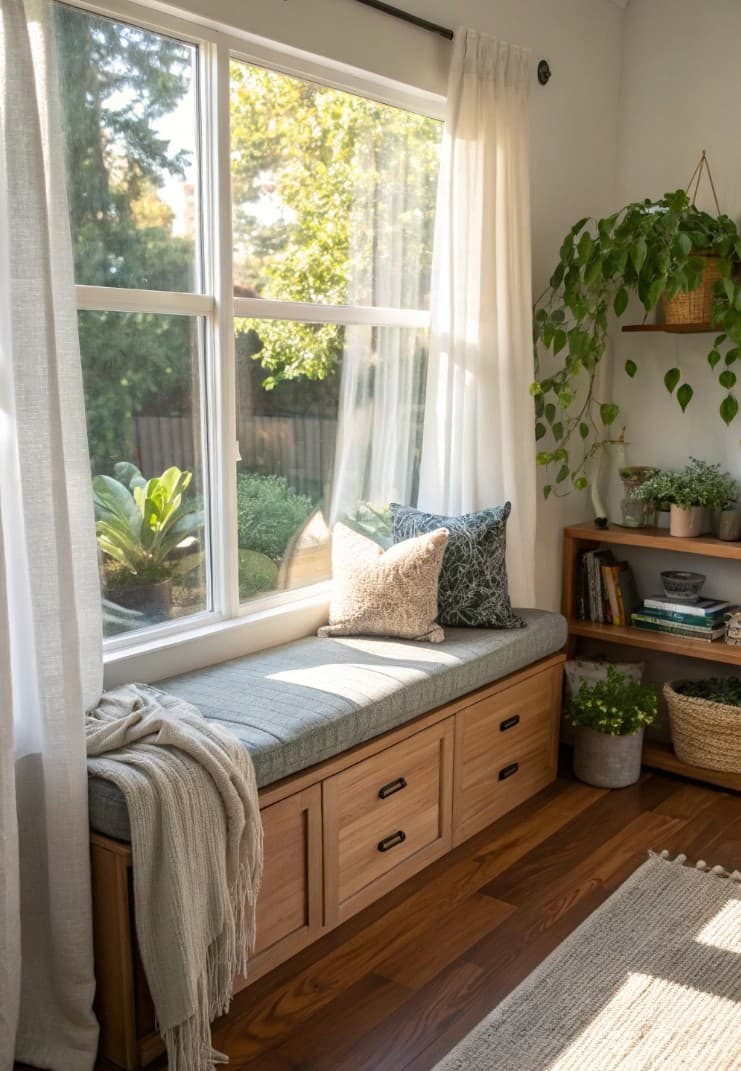
How to Build a Window Seat With Built-In Storage Drawers
A window seat with drawers underneath adds seating, storage and a reading nook in the space a window usually leaves empty.
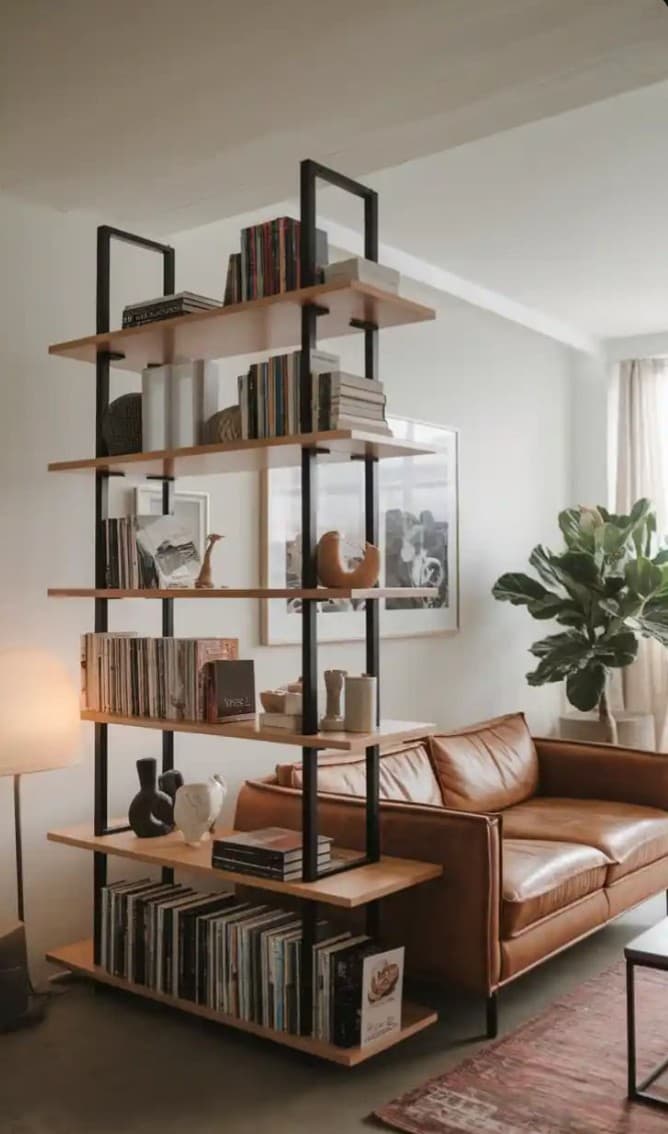
Industrial Shelving Units: The Statement Storage Piece for Modern Living Rooms
A tall black-frame, oak-shelf freestanding unit with books, ceramics and vinyl records becomes the focal point of a living room — here's how to style one.
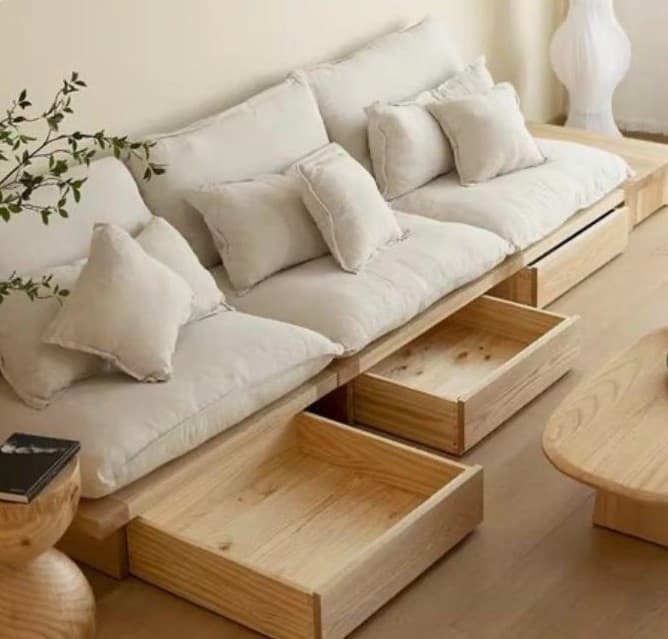
Japandi Platform Sofa With Hidden Storage Drawers: The Ultimate Space-Saver
A low pine platform sofa with pull-out drawers underneath stores as much as a wardrobe while taking up the footprint of a sofa. Here's why this is one of the smartest furniture ideas around.