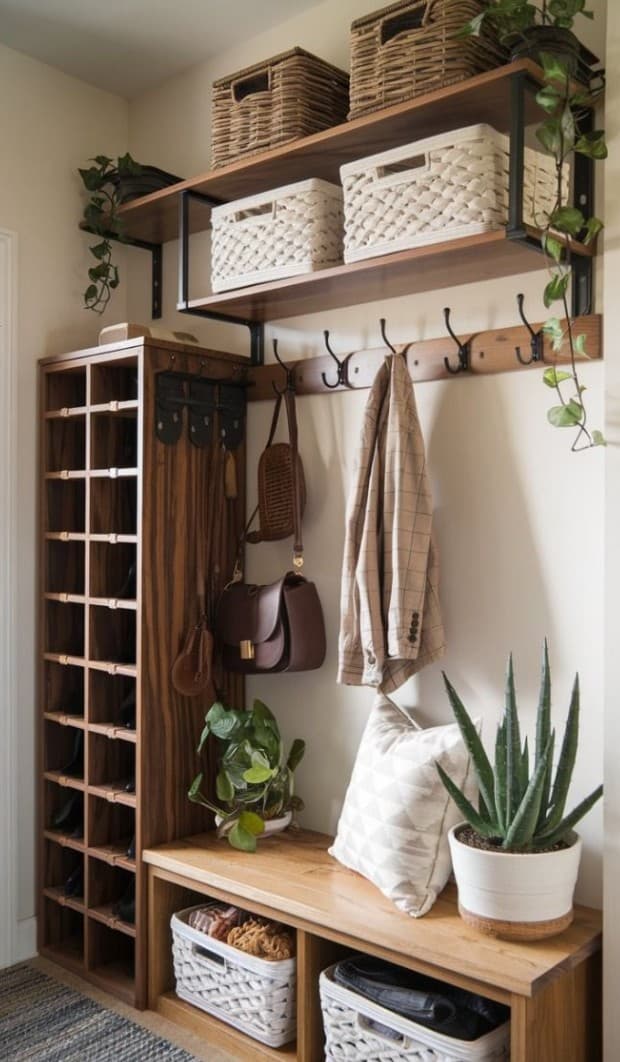
The entryway storage system in this image is a masterclass in layered organisation. Floor-to-ceiling shelving on one side holds shoes in individual cubby slots. A horizontal hook rail manages coats, jackets and bags. Upper shelves with wicker baskets handle everything that doesn't have another home. A built-in bench at the bottom provides somewhere to sit and stow. Every need, addressed. Every item, in its place.
The shoe tower
The tall cubby unit on the left — with individual angled slots for single shoes — stores far more pairs than a traditional shoe rack in the same footprint. Each cubby holds one shoe at a slight tilt, making it easy to scan and retrieve the pair you want. This style of unit works especially well for households with lots of shoes or families with children of different ages and sizes.
The hook rail
A long wooden hook rail with multiple hooks is the most functional thing you can add to a hallway. Hooks at different heights — some higher for adult coats, some lower for bags and children's jackets — make the system genuinely usable. The hooks here are black iron in a classic S or J shape, which suits both rustic and contemporary interiors.
Upper basket shelves
The shelves above the hook rail are used for wicker baskets — a mixture of closed white woven baskets and open rattan ones. These hold the overflow: scarves, hats, gloves in winter, sunglasses and sunscreen in summer. Baskets hide the contents while keeping them accessible, and they look far better than plastic boxes.
The bench with hidden storage
The bench at seat height is wide enough to sit on while putting on shoes and has storage baskets tucked underneath — perfect for bags you use regularly, gym kit, or a spare pair of shoes. A cushion on top makes it comfortable; a basket underneath makes it functional.
Interior tips
- Use warm-toned wood throughout — dark walnut or oak stained deep gives an entryway warmth that white painted units can't match.
- Add trailing plants at shelf height: pothos and heartleaf philodendron tolerate the fluctuating temperatures of a hallway better than most plants.
- A geometric cushion on the bench adds softness and colour to what could otherwise be a purely functional space.
- Keep the floor clear: the more floor you can see, the calmer and more spacious the entryway feels. Baskets under the bench should be pushed all the way in.
- Install good lighting: a hallway with poor overhead lighting undoes all the effort of good storage. A warm, well-placed wall light or ceiling fitting makes arriving home feel welcoming.
Planning the layout before you buy
The biggest mistake people make with entryway storage is buying individual pieces without a plan and hoping they'll work together. The result is usually a mix of styles that don't align, storage at the wrong heights, and wasted space.
Before ordering anything, take precise measurements of your hallway. Note the total wall length, the ceiling height, the position of light switches and sockets, and any doors that swing into the space. A door that opens into the hallway can limit how deep a unit can protrude from the wall — this catches many people out.
Then sketch a rough layout. Allocate wall sections to specific functions: shoes here, coats here, baskets here. Work out the order logically — usually coats and bags near the door (things you take on and off most frequently), shoes near the bench (where you sit to remove them), and general storage higher up and further in.
A useful benchmark for heights:
- Coat hooks for adults: 150–170 cm from the floor
- Coat hooks for children: 90–110 cm from the floor
- Bench height: 45–50 cm (standard seat height)
- Upper shelving: from 180 cm upwards, accessed with a small step stool when needed
Choosing materials that last
An entryway takes more abuse than almost any room in the house. Wet coats drip onto hooks. Muddy shoes sit on the floor. Bags are thrown and dragged. Children run in and out. The materials you choose need to be durable, easy to clean, and genuinely hard-wearing.
Solid timber is the premium option and worth the investment if your budget allows. Solid oak or ash will last decades and develops a beautiful patina with age. Avoid MDF in a hallway — it can't handle damp or impact as well as solid wood.
Powder-coated steel hooks and rails are virtually indestructible and extremely easy to wipe clean. The finish won't chip or peel from normal use, and they look just as good after ten years as on day one.
Rattan and wicker baskets are ideal for upper shelves because they're lightweight and easy to pull down and carry. For under-bench storage, choose baskets with a solid structure — flimsier ones collapse under the weight of shoes and bags.
Engineered wood (plywood rather than MDF) is a reasonable compromise between cost and durability for shelf units. Quality plywood is stable, strong, and holds screws well. It can be painted, stained or left natural.
Common design mistakes to avoid
Making the hook rail too short. In a family home especially, the number of coats, scarves, bags and sports kit hanging at the door is considerable. A hook rail that seemed generous when empty looks inadequate very quickly. Always install more hooks than you think you need — you can leave some empty, but you can't add capacity easily later.
Ignoring the floor zone. The floor directly under the bench gets dirty fastest. A removable, washable boot tray — either a simple rubber tray or a stylish wicker tray — protects the floor and gives muddy boots a home that isn't the general floor space.
Buying a bench that's too narrow. A bench needs to be at least 35–40 cm deep to sit on comfortably. Narrower than this and people will perch on the edge; children especially will lose their balance while pulling shoes on. If space is tight, a fold-down wall bench is a better option than a freestanding one that's too narrow.
Not labelling the basket system. In a family household, a basket system only works if everyone knows what goes where. Small labels (chalkboard labels, leather tags, or simple sticker labels) on baskets prevent the "where does this go?" chaos that defeats even the best-designed storage system.
Buying advice: ready-made versus custom
A fully custom hallway unit, built to your exact dimensions by a carpenter, will always fit and function better than any off-the-shelf alternative. The cost is higher, but for a permanent installation in a hallway you'll use every day, it's often worth it.
That said, ready-made systems can be excellent if you choose wisely. Scandinavian furniture brands offer modular hallway systems with interchangeable components — different bench heights, hook rail lengths, and shelf configurations that can be combined to fill almost any space. The key is to buy from a system where all components share the same depth and aesthetic, so the finished result looks intentional rather than assembled from separate pieces.
If you're combining ready-made storage with custom elements, the easiest approach is to buy a standard unit and build a simple surround frame to make it look built-in. Paint the wall behind and around the unit in a colour that contrasts with the unit itself, and the entire installation will look as though it was designed for the space.
Related posts
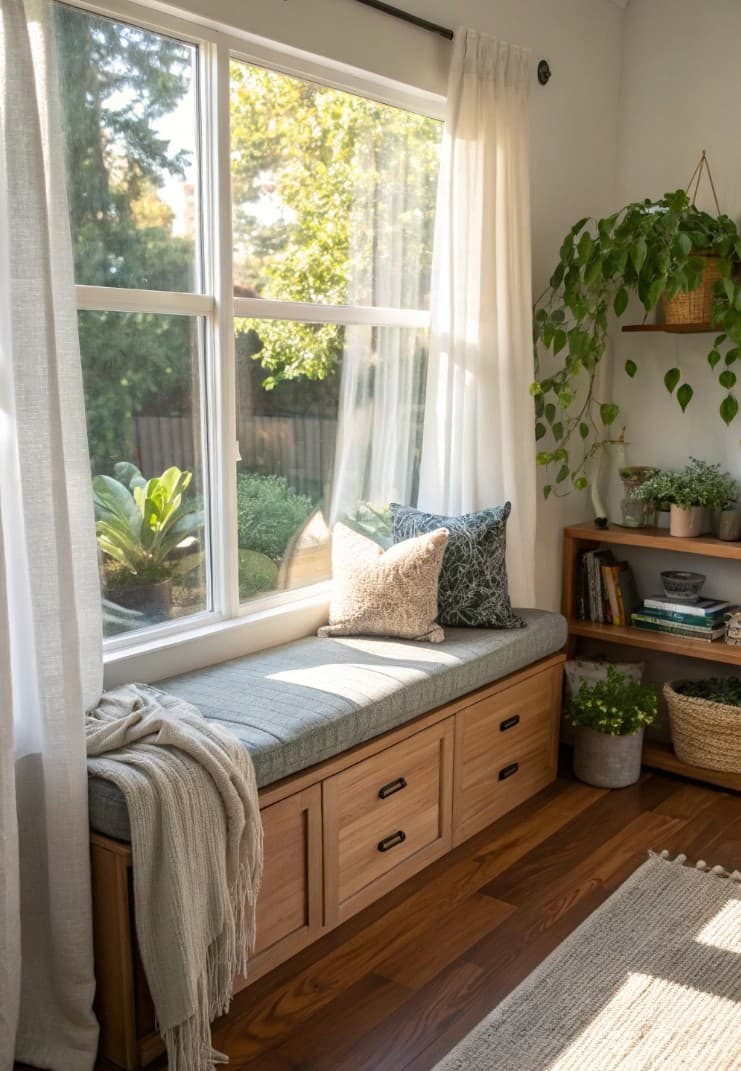
How to Build a Window Seat With Built-In Storage Drawers
A window seat with drawers underneath is one of the most rewarding home projects you can do — it adds seating, storage and a beautiful reading nook all at once.
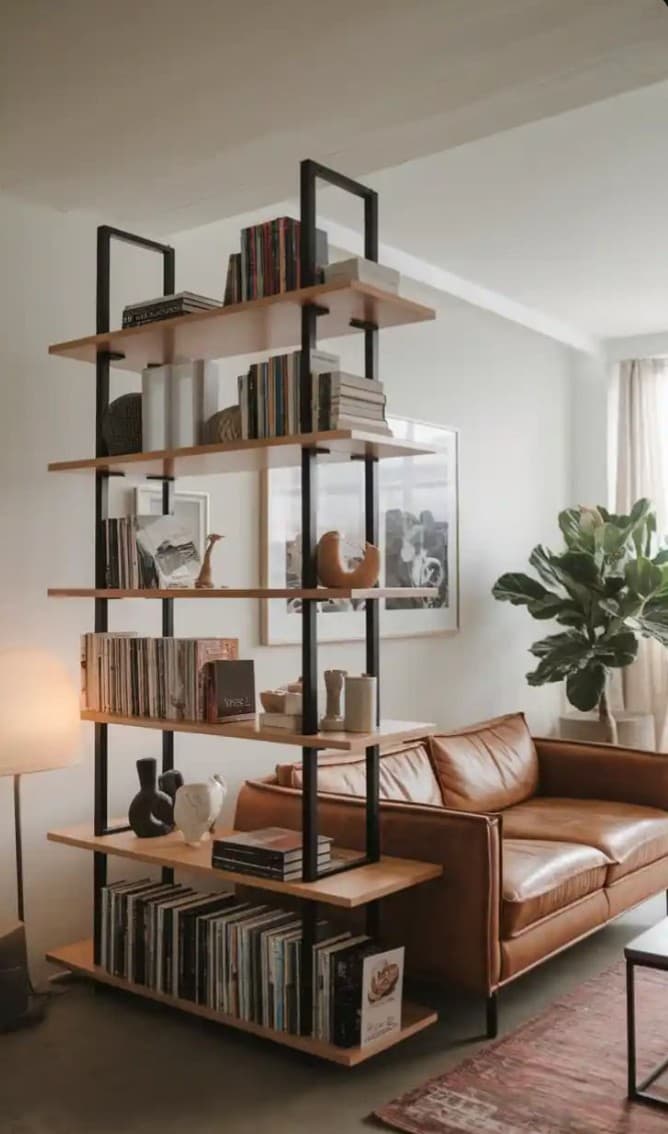
Industrial Shelving Units: The Statement Storage Piece for Modern Living Rooms
A tall black-frame, oak-shelf freestanding unit with books, ceramics and vinyl records becomes the focal point of a living room — here's how to style one.
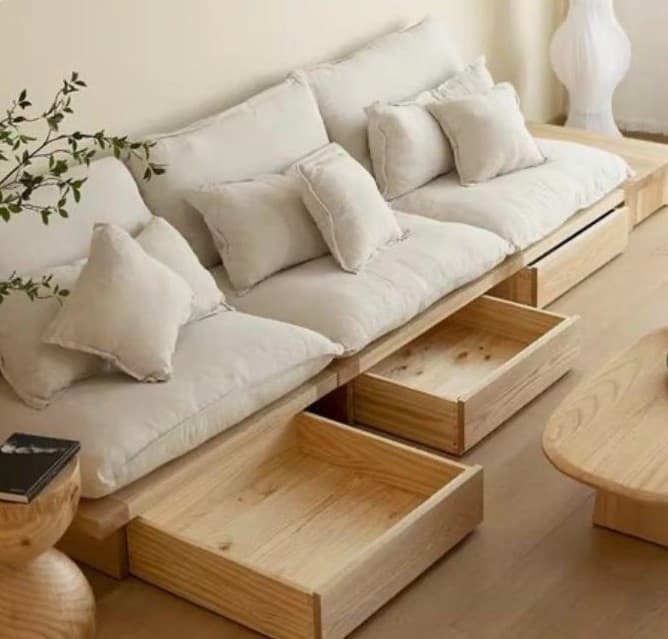
Japandi Platform Sofa With Hidden Storage Drawers: The Ultimate Space-Saver
A low pine platform sofa with pull-out drawers underneath stores as much as a wardrobe while taking up the footprint of a sofa. Here's why this is one of the smartest furniture ideas around.